Tuesday, February 8, 2011

Dear Brothers and Sisters. Today we shoot at you. Please hide well.

The above greeting was part of one of our favorite stories told by our tour guide during our recent trip to Fujian Province, the closest part of China to Taiwan. During the height of China-Taiwanese tensions the firing of artillery between the Chinese and Taiwan's closest piece of terra firma to the mainland was a regular occurrence. But the actual soldiers on the ground started to get a bit sick of the whole affair - hell, most of them probably had family on the other side of the straight, or knew someone who did.  So a 'gentlemen's agreement' was made between the two sides that China would fire their guns on Monday, Wednesday and Friday, and Taiwan would return fire on Tuesday, Thursday and Saturday.  Sunday would be a day off.  The above greeting was one that was recited by the Chinese Army at Xiamen, over the massive loud speakers that point towards Quemoy island only 2km off the coast of Fujian (and which belongs formally to Taiwan).

Our tour group this time was a really nice combination of people, albeit with the usual personalities that we have come to expect from CCC tour groups (which primarily services expats).  There were the quiet Europeans, who tend to keep to themselves and rarely say 'boo' at the lunch and dinner tables.  There was the person (historically almost always American - sorry Molly, but we've had an Aussie too :-) who thinks that everyone they make eye contact with wants to know their life story, and can't get enough of their own voice.  Then there is the China long-termer who, over the course of the weekend, will not advertise it but will show that they can walk the walk and not just talk the talk.  If you listen out you'll hear their almost perfect Mandarin, and if you take the time out to chat with them will find that they have got quite a few years and more of living and working in China under their belts.


Not For All The Tea in China
There's an old joke in China that Adam and Eve could not have been Chinese, because Eve would never have eaten the apple - she would have eaten the snake instead.  And when our local Fujian guide told us that that she was planning to read the entire book on "Things Chinese Don't Eat" in under 5 seconds, we knew we were really close to the Cantonese region in China where anything not nailed down is fair game for the cooking pot (and where rat, cat and snake are standard menu items in the more local eateries).  We did manage to avoid the rat and the snake (which most in the group would have avoided at ANY cost - wowsers), but the cuisine was certainly different to what we are used to up north.  The seafood was actually fresh from the ocean, rather than aqua-farmed (which gives a dirty taste to everything), and the use of chicken and duck more prevalent than up north.  Still, some staples pop up anywhere in China (good ol' tomato and egg).

But in saying that you just would not eat some things for all the tea in China is a big call, because there is ALOT of tea in China.  And Fujian is one place that gives you an idea as to just HOW much.    The tea plantations extend as far as the eye can see (Oolong being the biggest variety down this way), set on the side of every piece of available hill.  But it's not the only crop in the area - tobacco and rice are grown in the same plot as alternative season crops (anyone remember the Simpson's "Tomacco" episode?  Sticky rice with that addictive Winnie Blue aftertaste).  Bamboo, sugar cane and bananas also grow abundantly, and although the soil and flora looked a bit dry at this time of year the locals certainly didn't appear like they went hungry.


Oolong tea plantations of Fujian in the foreground and background.

But enough of the overview - it's the sites and the local culture that we were there to see.  The Clan of the Hakka Han actually have alot of street cred to their name.  The richest Asian man in the world  - Li Ka-Shing - is Hakka, as too was Mr Modern China himself Deng Xiao Ping.  The former captain of the Flying Cocktails is Hakka.  And then, if that's not enough, Hu Jintao visited the Hakka Villages once last year and from then on all has been glorious (well, at least the 2 metre by 4 metre billboards with his mug on them have).

Our first stop along the Hakka trail was a scenic spot high over a traditional Hakka village known as Tianluo Keng, nicknamed "Four Dishes and One Soup" for its shape.  We were not surprised to be told that the place was popular with tourists (it's regarded as the most beautiful by the local people), but we had no idea about HOW popular until we were required to walk down to the scenic platform through a huge traffic jam in the middle of nowhere from 400 meters up the hill.  Our first sight of the Hakka architecture from up high was impressive, notwithstanding the bad angle of the setting sun which made taking any decent photos nigh on impossible.  But there's always the serenity, right?  Wrong.  Thanks to Chinese tour group leaders and their love of mega-phones, you are never out of ear-reach of a high pitched voice in Chinese espousing the "beautiful nature".  Back up on the road the traffic tension really took a turn for the worst.  While I wasn't there to see it personally, according to trusted eye-witness accounts (i.e how Maddy described it) there was"a BIG fight, and a guy nearly killed another guy and tried to throw him over the edge of the road".  Minus the Death Match that I had pictured in my mind, it was still by all accounts a pretty solid punch-up that was actually started and further provoked by an old guy taking issues with a younger guy in a car.  In a situation where I thought youth and enthusiasm would outlast old age and deception I was well and truly wrong, as the old guy started to show the younger generation that growing up Mao style built more than character - it also built survival instincts.  Lucky the issue was later resolved as both parties decided to go their separate ways (which was lucky, as Maddy wanted to do Hapkido to break up a fight).


The "Four Dishes and Spoon" Hakka Settlement


The traffic jam heading down to the Hakka Village.

After this we headed into a small village to get up close and personal with the Hakka architecture. These buildings are vastly different to anything else found in China.  Up to 5 stories high, they are like a big donut - one big roundhouse (and naturally the only type of dwelling that Chuck Norris will live in) or in some cases a square house.  The style was initially adopted for the purpose of protecting the residence inside from roving barbarians, thieves and neighbors who were upset with these new intruders from Northern China (where the Hakka Han are believed to have originated from, pushed south-East by the expanding empire of the North).  With only one door into the compound to guard, no windows on the first two floors, well stocked storage rooms and internal water wells they could outlast a siege for anywhere up to 3 or 4 weeks.  These days, with the threat of barbarians and thieves having long since passed (they've all moved to Silk Street now), the modern day Hakka tulou now houses up to 4 generations of the same family, and is passed down to the eldest son but with room at the inn for all.  Other tulou's have leased out their individual rooms to residents and businesses (and will cost you a couple of rmb to go up for a look), while others are open to tourists as inns and guest houses, and play an important part in the local economy.

One of the bigger tulou buildings (four floors for this one).

As with any tourist site in China, a very crafty (if somewhat repetitive) tourist souvenir market has built up around the tulou region (although no Hakka-house shaped hat I'm afraid to say.  I'll contain my disappointment for times when I'm alone).  Of all the reminders you can take away the award for most effort has to go to the souvenir photographers, three of who jumped in behind our tour guide when she was taking the group shot and took their own snaps.  The winner of the three was the lady who'd run back, printed it out, put it into a souvenir frame and was trying to tell them to the group before we had even got to the door of the tulou (less than 3 minutes).  Against the usual run of the grain, a number of the souvenir shops inside operated in fixed-prices, so no hope of haggling for a lower price no matter how much I tried (even the good old fake walk away failed).


King of Tulou from on high.  Note the multiple rings.


Vendors in the King of Tulou.

Traditional 5-star, Hakka-style
So by this time we'd seen the tulou from afar, seen it from up close, and now it was time to get up close AND personal as we headed off to our accommodation for the night - a traditional Phoenix style Hakka House (aka the Fuyu Tulou) where we would actually be spending the Friday night in one of the hakka houses that had been converted into a guest house.  They'd warned of a lower than usual accommodation standard, and they weren't wrong as the rooms were even more basic than the accommodation we had in Hemu village in North Xinjiang (where the shower was over the squat, and the water was provided in a bucket).  Still, the beds were comfortable, the blankets were ample, and quite frankly we were so tired from the early flight that we would have slept through CNY in Beijing all over again.  And the broken pink plastic "Strawberry Shortcake" vanity mirror added that touch of class that separated it from the luxury of even the most expensive Shangri-la hotel.  There was even a late night impromptu Chinese dragon dance by locals along the river next to the inn, which Maddy and I saw as Amy was tucking herself into bed.  Breakfast was basic, but offered the biggest selection of breads I've seen outside of Baker's Delight (or Wei dou mei - Beijing's equivalent).  The whole experience reminded us of our stay in Hemu village, in northern Xinjiang Province.  Although the Tulou was basic, China is proving to be very modern in relation to internet connection with the hotel having Wi-Fi from the outside restaurant (which was right near the coffee maker).  After a coolish night and sleep broken by new years fireworks (the loud cannon variety) we feasted on a breakfast of 10 different bread varieties and partly gelatinous hard fried eggs.


River beside the tulou accommodation.


Maddy resting up in our very basic room at our tulou accommodation.

The Fact and the Fiction
Another story told over the course of the weekend was a great one involving the US intelligence agency, who upon seeing the tulou buildings on satellite images (and thinking they were nuclear missile silos, this being Cold war time and all) sent two American agents into the Fujian countryside posing as tourists.  After meeting all the locals and checking out the buildings the two agents came to the conclusion that the only future threat to the USA was the possible dumping onto the US market of 1 million excess tulou key rings and hakka house snow globes.  With US snow globe and key ring manufacturers duly warned they headed back with their packs loaded to the brim with tulou ashtray and the last of the hakka house oven mitts (the obvious reason why I couldn't find one at ANY souvenir shop - 'sigh').


The epic FAIL of this concern about Hakka-style missile silos became even more apparent as we were required to chill out at the tulou of a local family while our bus negotiated its way through ANOTHER traffic jam.  Mr Jian, the older brother of the family, proved the most gracious host serving us tea and snacks and (through the translation skills of our guide) gave us the low-down on his humble abode.  Luckily once the bus got through to us, our local our tour guide Anne got out and walked ahead of the bus for the drive out, facing down any car that decided to try and play chicken with our prime people mover and telling them to rethink their last navigation decision.


One of the young residents of the tulou buildings.


The other smaller houses and farms around the bigger tulou buildings.

Our last Hakka stopover was to a little village that has recently been renamed "Love Story", because of the filming of a movie of the same name that took place there.  It offered a lovely stroll along the river and under huge banyan trees, before we got back on the bus and headed back to Xiamen for check-in and dinner.


One of the HUGE banyan trees in the village called "Knot"/"Love Story" (named by the Chinese Govt of course).

Despite the excessive numbers of tourists the trip west into Hakka territory is one that I would highly recommend (albeit at a less busy time, if there is such a thing).  If the pictures of the scenery aren't enough to consider the trip a win, the picture I was able to nab with a PLA soldier certainly is.  Such a thing is a rarity in China - they tend to be way too serious in Beijing, but in this case this fellow (and later his mate) actually came and asked me.  No doubt the photo will be stapled to his next job application.

If there was any negative side to the whole trip it was our observation that China has a long way to go to address its rubbish disposal problem.  The piles of refuse were everywhere in the Hakka villages, and on one occasion included a whole pile of used firecrackers which periodically showed that the gunpowder within was not entirely expended.  The Central Government really needs to get compost happening at a national level.


The dirty side of rapid progress.


One of the many friendly locals in the village (although this guy was actually from Fuzhou, the capital of Fujian located further up the coast).

In terms of domestic chores like washing of clothes, the villages in the Yongding area are (in most cases) the land that time and technology forgot.  Alot of the washing of clothes and vegetables is still done by hand in the river, in water whose cleanliness is questionable given the amount of rubbish floating in it (one local was assigned to pluck the rubbish as it floated by, but was doing a half-arsed effort at best).  Minus the rubbish-dump spots around the place, the village was as close to the misty Chinese village among lush green mountains as I have come, although just out of season as the vegetation was looking a bit on the thirsty side.


Doing the washing the old way.


The Coast with the Most
If it wasn't for the Chinese signage one could stand in some areas of Xiamen at night and be mistaken for thinking they were in Broadbeach or other areas around Surfer's Paradise.  But not in a negative way - rather in a "this place has money" kind of feel.  Xiamen appeared from the outsider looking in to have a more mature taste than most other parts of China.  And it's not surprising.  Xiamen was one of the first ports to be opened up for trade with the west and many overseas Chinese are from this province.  As a result they have had a lot longer exposure to western clothes, quality imported products and in particular western architecture.  And nowhere was the latter more obvious than when we headed off to Gulangyu Island on the last morning of our trip just 5 minutes by ferry from Xiamen Island.    The place was actually crammed with tourists (shoulder to shoulder in some small alleys), and the beach looked like the classic beach picture in the original "Where's Wally" book (except if Wally was really lost on the Gulangyu beach, I'd call off the search immediately and pronounce death by mis-adventure).  Our opinion then (and now) is that the local authorities really need to limit the number of visitors to the island at any one time, as it was really unpleasant unless you managed to escape to the local residential areas.  We did manage to find our way there by mistake, and after giving one friendly local the slip who was intent on being our "free guide" we  really enjoyed the peace and quite albeit for a short while.


The busy Gulangyu Beach.  No swimmers or beach chairs, just a whole lot of Chinese tourists standing around in smart casual wear.


The busy streets of Gulangyu.


The old western-style architecture of Gulangyu.  Many of the businesses are located in old consulate buildings or villas built by foreigners many years ago.

In the western areas of the island the former residence and consulate buildings of foreign countries gave the streets that real Hong Kong feel about them, inter-dispersed with quant little boutique hotels that charge through the roof for the location, location, location.


Xiamen - one of the first Chinese cities to open to the west, and to get all of the western culinary atrocities (except at 3am, when a 5hr old McDonalds hamburger is perfectly acceptable).

Back on the mainland for a quick walk around, and it was a case of more leather shorts than Oxford Street in Mardi Gras (although it was the women who were the culprits here).  A large group of us were well and truly in need of a caffeine fix though, and managed to track down a coffee shop for a quick relax before we were back on the bus and on our way to the airport for the return flight home.

We are looking to head back to Xiamen in June, when we have been told that the crowds will be smaller and the weather the best (although the weekend just gone really was shorts and tee stuff for us, even if we did get "you're abusing that child" looks from locals for letting Maddy go t-shirt).


Modern Xiamen Island from the water.


Xiamen's answer to Australia's Big Banana, Big Oyster, Big Merino, Big - the Big Energy Efficient Light Globe.  Theme park opening soon.


Maddy doing the Rock 'n' Roll look around Fujian.

Thursday, February 3, 2011

The Final Countdown

No, I'm not talking about that 80's cockrock song (as classic as it is), but rather the realisation that we only have 11 months to go before we are likely to resume our normal lives back in Canberra (not that I can ever be classified as 'normal').  While I'd like to avoid cliches at this point, it is actually quite amazing how fast 25 months have flown by.

We've certainly tried to squeeze all of the goodness out of the opportunity that we could, knowing that if we don't get another chance in our lifetime then we'd go back to our home in Canberra happy and grateful for the experience.  We've tried to see as much as we can, written about it way too little, and made some great friends along the way (and sadly said goodbye to some).

To say that living in China has been an absolute blast would be an understatement.  There will be things that I certainly will NOT miss when I go, but there will be things that I will miss dearly.  But where to start on a list for either?  Probably after 2 bottles of red.

Things I Will NOT Miss
  • Walking down the street and seeing a kid taking a dump on the footpath.
  • Having to dodge frozen lung butter on the footpath (ie goobers the size of a newborn elephant)
  • Sitting down in the non-smoking section of a restaurant, only to find I've been seated next to the Marlboro Man himself.
  • Getting aforementioned Marlboro Man as my taxi driver, even though there is a non-smoking policy in taxis (resulting in me taking yet another photo with my phone of a Taxi Driver's details).
  • Getting asked by a taxi driver to "Get Out", because he's not wanting to go in the same direction that I want to.
  • Looking outside and not seeing two feet in front of you because of the "fog".
  • Driving skills of a 1930's rural Australia.
  • The beratings I get from taxi drivers for not getting one of my Mandarin language tones correct.  Here's a deal, Mr Taxi Driver - you have a shower this year, and I'll correct my tones.
  • Shit TV
  • Having to go to 5 shops to buy all the stuff on the shopping list.  "Hot and Cold" as a descriptor for stock availability just doesn't cut it.
  • Having that feeling after EVERY purchase that I've been done over on the price.  So looking forward to a return to fixed prices.

Things that I WILL Miss
  • Our first year of weekends in China.  No weekend kids sports commitments, no planned activities (social outings excluded), and no household commitments.  The absence of routine Saturday offspring activities can be a sweet, sweet thing.
  • The innocence (and righteousness) of childhood in a very multicultural setting.  In all of Maddy's friendship 'issues' it's been the usual peer pressure as the first culprit, followed usually by the group power struggle, and so on down the line of personality traits.  In all cases the excuse of "she's Korean/Chinese/Japanese/" has NEVER rated a mention (as it shouldn't).  The tea leaves bode well for a world view, and we thank China for the tea.
  • The MIGHTY Flying Cocktails - dear friends I have made, and dear friends I will miss (and others who I've already had to farewell).
  • Chinese New Year.  It's the night that Chinese people forget they live in China.  Rules are disregarded, authority is thrown to the wolves, and anarchy is embraced faster than bai jiu at a Beijing banquet.
  • Shit TV (hey, they're STILL ninja movies).
  • Conversations with my Chinese guitar teacher about life, faith, and politics.
  • Those who I've dined with, and wanted to dine with a second time.  
  • The adventures, the travels, the encounters.  China cannot be adequately described in a TV series or even an epic Lonely Planet guide.  I've read plenty of books about people's own views of China, and not one of them relate in any way to mine.  And in all honesty, my view of China now is unlikely to relate in any way to my view in another 5 years time.
  • The total lack of self conscience in the older population.  They dance in the street, they sing in the park, and they don't give a rat's arse what other people think.  Perfect tonic for the modern western world.
  • The pulse of a city (but one showing signs of a forthcoming cardiac arrest in many areas - traffic, development).  But while the pulse may eventually slow in the daylight hours (or in the case of traffic, come to a grinding halt), it's the night that will continue to be WHERE IT'S AT!.
  • Roubian, late night Jian Bing, and this little salty pancake with an egg that proves the quintessential breakfast on a rushed morning (two for AU$0.60).

There is no doubt I'll come up with more as the countdown continues, but as is the way here they will usually rear their heads as a direct result of an incident that is just as likely to leave me smiling and hopeful, as it is to leave me pissed off and cursing.  But in the words of many before me (who were alot more experienced in these affairs), "That's just China".

The Eternal Spring - Part 1

YUNNAN.  Only 10 months ago the thought of China's southern province and gateway to Vietnam and Cambodia conjured images of very contradicting landscapes.  On one hand we had seen many programs on the TV about Yunnan having "the most dangerous mail delivery route in the world".  The type you imagine in the mountains of Peru, where locals traverse villages built on either side of a fast-flowing river and deep canyon via a single flying fox.  On the flip side were stories of the severe drought hitting the region, making it even harder to grown crops in soil that has already been farmed to death.

The reality, although invoking the potential for such images, was not at such extreme ends.  Yes there were some very barren sections, and others that were lush and irrigated all year round. There were even Australian eucalyptus trees growing on the slopes around Kunming and in Lijiang.  But the hue of the landscape aside, it was the stuff in the air that was the region's best attribute - I'm talking about nothing - just good old-fashion healthy AIR.  No chemicals, no smog, no whatever the hell else they pump out of Beijing chimney stacks that makes my living room air filter flash green (which means that while you may not smell the cyanide, it's actually lingering just below the surface and ready to strike - just like puberty in a Chinese airline pilot).  It was also one of the province's that claim the most ethnic minorities (as does Xinjiang, where we visited earlier in the year). The number of minorities groups is so great that if you were to buy the traditional head piece of all of them, you'd take longer than the Pope to pick a matching skullcap for your choice of outfit.

Our plan was to start at the provincial capital of Kunming, and then head north-west and upwards towards the Tibetan plateau and aclimatise to the altitude as we went.  We would eventually make our way up to 4,400 meters (if only for a short while), but with memories still lingering of a 4hr headache after our Xinjiang Karakoram Highway trip I was not looking forward to altitude sickness again.  I was once told that Han Chinese suffer high altitudes more than most, as do those who are uber-fit.  Well I'd been duped on BOTH of those accounts already, but this time I was EXTRA prepared.  Under my belt this time was 8 weeks of my patented "NO physical training whatsoever" training program, and I'd had a few glasses of wine every night just to ensure I'd forgotten even the most simple of Mandarin words.  I was sans Chinese,  sans Iron Man body, and ready to tackle altitude sickness head-on Tommy Raudonikis -style.

We'd purposely chosen to travel in the area outside of the peak tourist season, with the aim of being able to take at least one photo without 500 chinese tourist heads bobbing away in the foreground.  Only time would tell if she was friend or foe.

Kunming
The first thing that caught my eye as we left Kunming airport on the way to our lunch restauarant was a big statue of a wine bottle.   How promising is that? But if there was one big novelty monument that would best epitomise Kunming it would be a giant mushroom, with a grass hopper sitting on top smoking a chinese cigarette.    It's a mushroom lover's heaven, as we found out when we tucked into a big mushroom hotpot with 5 or 6 different fungal varieties.  Already we'd noticed the different costumes of the waiting staff (dressed in the Sani traditional outfit, the predominant minority in the area), but still something was familiar - chilli sauce, in all its varieties.  We were to discover that it's a big thing down south, and goes very well with mushrooms.  But fear not, fellow carnivores - there was a meat option, but to be honest (and I can't believe I'm saying this) I much preferred the vegetarian options in this case.

To be honest we hadn't really done our research on the towns we were visiting, but that seems to be the way we do our trips as we tend to leave it to those in the know to know the best places to go.  Of all our travels around China this approach had really only bombed out on a few occasions  - way too many museums on a few trips, and then there was the Germ Warfare Museum on our Harbin Ice Festival (HappyLand THAT was). Kunming certainly didn't make this black list as our first trip was out to the famous Stone Forest, a large area made up of large limestone rock formations formed by water erosion when the area was submerged around 270 million years ago (give or take a few days).  In typical chinese kitsch form (in this sense meaning all the Chinese tourists love it) they had names for the ones that resembled animals and objects other than just 'rock'.  Even so, when one overlooks the over commercialism of the place and the excess number of tacky tourist shops it still is a great natural wonder.  From the viewing platform high above we could see the tropical vegetation that supported Kunming's claim as the "Eternal Spring".

Kunming's Stone Forest

Kunming's Stone Forest

It was here that the head dress of the local Sani minority girls caught my attention (many of whom where acting as tour guides).  The hats they wore had two little fabric pieces on the top that resembled cat's ears, and there seemed to be no pattern to whether they were pointing up or down.  Some females had both their "cat's ears" pointing up, others both down and others again had one up and one down.  Just when my temptation was building to go and point one down I decided to ask our tour guide what they meant.  Gotta say it was the luckiest course of action in my life up to this date, as the guide explained that both ears up meant single status, one up and one down meant they were engaged, and both down meant marriage.   If a male wanted to propose to a single girl they simply go over to them and turn down one of their "cat's ears".  Phew - could have been an arranged marriage right there if I'd poked around with the pointy bits too much, requiring some real explanation to Amy.

Sani minority group dancing at the Stone Forest.  The spectator in the blue jacket is really getting into it.

The next day our first stop was meant to be the museum, but unfortunately (or fortunately, depending how you look at it) the museum was actually shut.  It did give us a short moment of concern, as alot of Chinese monuments are closed on Mondays and any Chinese tour company worth their MSG should know that.  Could it be we had ourselves a FAKE Chinese tour company at the reigns of our tour plans?  Thanks to some quick thinking from our tour guide she gave us a few alternative options and instead of moseying through what would have been 90 min of Maddy complaining she was bored (and doing cartwheels around thousand year old artifacts) we headed into the main part of town to check out a couple of pagodas (a staple meal on any China Culture Centre trip) and then the bird/reptile/arachnid/insect market.  In an exciting twist we also wandered into a large market selling all kinds of local delicacies, allowing me the opportunity to have my first nibble of fried grasshopper along the way (surprisingly delicious) and see how they make chili in catering packs.

Big pots of chili paste being prepared and sold at Kunming's "Eat Street".


Our last worthy spot on the Kunming tourist trail was up a chairlift for a great scenic view over Kunming from Western Hill and Dragon Gate.  It was from here that the less developed and less polluted nature of Yunnan became apparent.  Yes there was a bit of smog hanging over Kunming, and they have had to undertake a big cleanup of their lake to make the fish from it edible again, but the city didn't look as impersonal and cold as all of the other Chinese cities we have visited.  Like a bigger Vancouver in a way (apologies to all the Vanouvians/Vancouvettes/??).  And I'm still not convinced that the smog was created by factories - it's more likely from the 90% of the Kunming population that take advantage of the region's reputation as a quality tobacco growing area, and who are single handedly puffing the world towards an early ice age.

Green Lake from Dragon Gate.  The highway you can see on the left goes all the way to Hanoi.

It wasn't only daytime that held great appeal for us in Kunming.  The nights were very pleasant temperature-wise. Bringing our stay to a spectacular end was a great night out at a show called "Inspiring Yunnan".  Showing dancing and music from all of Yunnan's minority groups, the choreography made Riverdance look like a primary school play.  The drumming was reminiscent of the Olympics opening ceremony performance, and when combined with one particular silhouette dance by a double-jointed local lass from behind a curtain it kept all of the crowd (and especially the men) transfixed for the entire 90 minutes.  The show does tour outside of China, so if it comes your way be sure to check it out.

So next it was off to Dali, and with a 8hr drive away as the only other option it was alot shorter flight to drop us into the middle of Bai minority country.

Dali
Landing at Dali airport is a real last-minute deal, if only for the passenger (I assume the pilots had it all under control, when not reading their Enid Blyton books).  One minute you are looking out the plane window and watching the miniature features of a landscape 800m below, and the next second the runway is 50 meters below you as you come to touch down on a flat plateau high up in the hills surrounding the city.

The city itself is at 1400 meters, meaning that we were really starting our climb up so where sure to take it easy and not rely on short sprints.  Our tour guide in Dali was Alice, who's mother was Han Chinese and her faterh was Bai Minority. She had been lucky enough to go to Uni to do the English for Foreign Tourists course.  And again the impressive language capability of even those Chinese citizens in the back-block of the country became apparent, as we found that Alice was fluent in English, Mandarin AND her 'native' Bai tongue.

Bai lady at the Dali market.

Fresh BaBa bread being baked by a vendor at the Dali market.  It was VERY tasty.

Central to Dali's economy is another massive lake ('Erhai'), this one actually clean enough to sustain a busy fishing and recreation industry especially in high tourist season as the locals take boatloads of tourists out to observe the Comorand fishing and a bit of impromptu duet singing from the boat captains.  As we experienced on our day out on the lake, when our boatier with a "Canberra Garden Club"-style hat joined the Bai guide on the boat next in a scratchy yet still appreciated rendition of a local love sonnet.

Comorand fishing on Erhai.


Our boat captain on our Erhai Lake adventure was all about colour.

After the boat ride and lunch at a great restaurant we headed off to check out the three pagodas of Dali.  Built hundreds of years ago, they were surrounded by lovely gardens but more recently have been accompanied by a new and VERY LARGE temple complex starting behind the pagodas and working its way up the slope of the mountain behind.  The new temple was on the site of a former temple complex, and the Chinese Government had invested alot of money to rebuild it for the sole purpose of attracting the tourist dollar.  As with most large-scale tourist sites all the typical bits of superfluous infrastructure were in place - electric buses to take you to the top (and bring you back down), snack stands, places where you could (for a cost) dress up "Bai" style and get your picture among the surrounds.  It did offer though GREAT kodak moments of Erhai, and so we decided to extend our stopover here and spend an extra hour wandering through which afforded us some great vistas.

The 'Six' Pagodas of Dali (3 actual buildings, and the 3 reflections in the pond).

Three pagodas, temple and Erhai.

The Dali old town itself was a bit of a disappointment.  Looking very similar to Pingyao with its gate and row upon row of same-same shitty tourist shops, I had been expecting to find a place lined with quant little coffee and tea shops with plumes of mary jane smoke pouring from their doors.  I'd read that Dali had a reputation as a hippy hangout, and although we did get one or two offers of "smoke smokie" from old Chinese women, most of the Old Town's main street was a line of Han Chinese all trying to sell us the same cheap souvenir.  There was the opportunity to continue on my testing of the local culinary delicacies, which in Dali's case was a fried local cheese that was brushed with oil and cooked over coals chun'r-style.  And as I would have expected from cooked cheese, it was pretty specc'y indeed.  At a stretch, the presence of three guys dressed up as Monkey, Pigsy and Sandy at the end of the street did provide for some amusement, but as in most cases in China the opportunity for a photo doesn't come without you dipping into your wallet.


View from our lunch table in Dali.

So Dali was done and dusted, and to get to our next destination of Lijiang required a road trip of northern Xinjiang proportions - a 4hr drive to go 180km, on a stretch of road that I'm told represented the BEST sections of the 'highway' between Dali and Lhasa (capital of Tibet).  Stay tuned for Part 2 of our Lijiang adventures in the coming week as well as a place called "Shangri-la", which although was absent of the divine beings I was expecting from such a place name, did offer divine food, divine kodak moments and a divine Tibetan barley firewater that actually made ME feel like an invincible god-like creature after just one glass (until 5 minutes later, when I realised Gods shouldn't be suffering post-firewater vomit burps).

Xin Nian Kuai Le ya'all. (Happy Chinese New Year).


Friday, October 1, 2010

Progress: The Enemy at the Gates

Those who have visited us here in Beijing would have been taken on a Guihot tour of The Village - that big Lego-land shopping centre a Beijing city block away from the Australian Embassy. It’s modern in design, was opened just in time for the Beijing Olympics and although it took a year to get the emerging Chinese capitalist middle-class excited, these days it is packed to the brim on any given weekend with locals wanting to buy all the big-ticket fashions, stuff their faces with McDonalds and Starbucks, or just ‘hang out’ at what is (or was) Beijing’s first official Apple Store - crazy night out. It’s the heart of Sanlitun – the kind of place that the young locals are happy to be seen (and even happier to spend their money).


Sanlitun Apple store this week - the iPad and iPhone 4 had arrived 

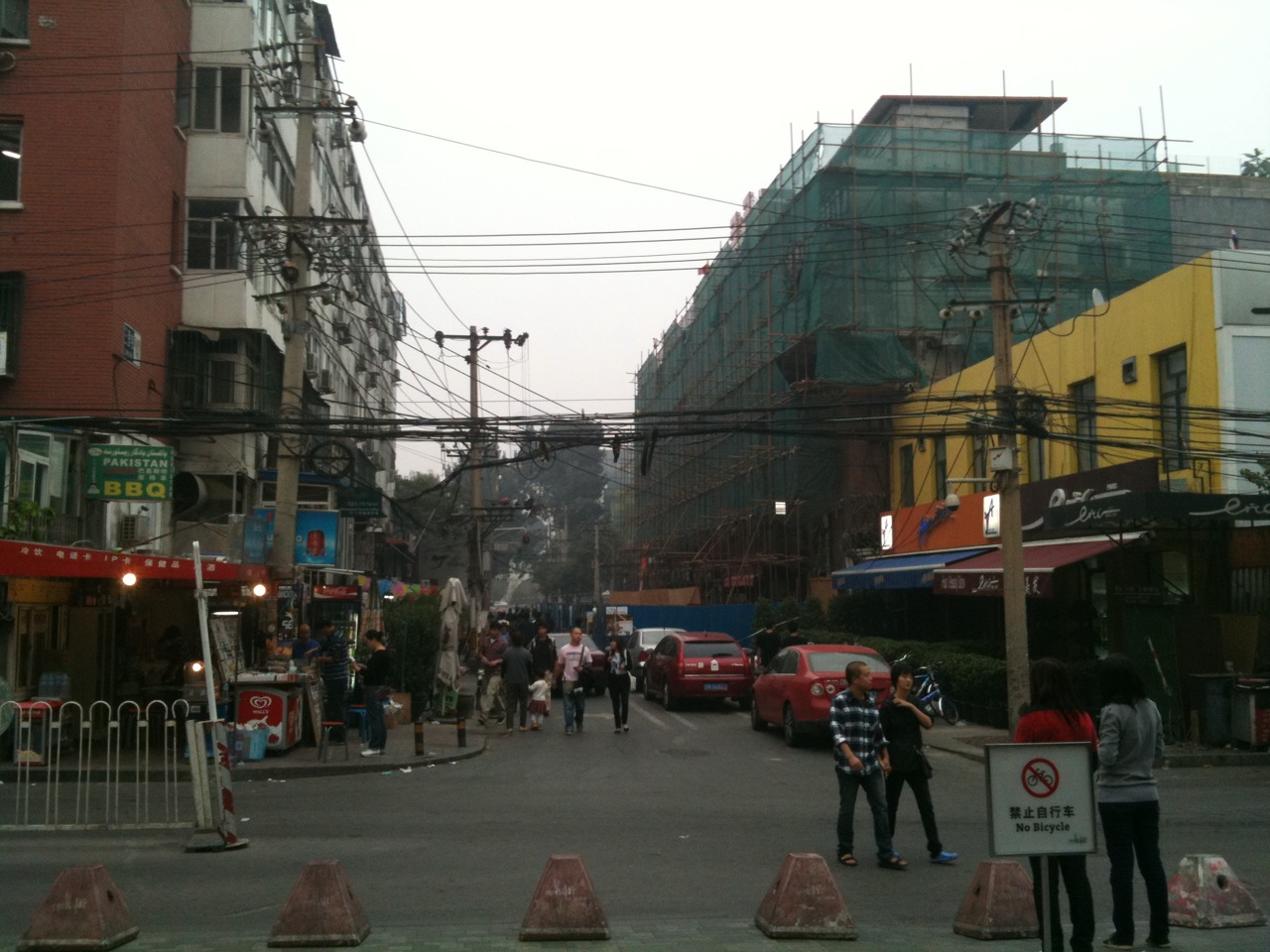
Directly to the north of The Village and separated by nothing more than a 10meter wide street is a vastly contrasted scene. It’s old Beijing, made up of a main street/alleyway running north-south with all the visual characteristics of an economy just waking up from a long socialist sleep, only to find capitalism lying in the bed next to them. One side of the street is made up of a series of “30 square foot basement bars” lined up one after another (where the only thing different is the name), the obligatory rip-off DVD shop, a run-down Chinese supermarket and a few tobacco stalls that sell more than just tobacco smoking devices. Add in one or two sex shops, a bike repair stand and a smattering of tailors and you have the type of street you'll find in many areas of the more westernised Chaoyang district, but maybe you’d have to look down a side alley for.

The other side of the street sees itself as the more highbrow. Sure the doner kebab shop is there, but the Frenchies have also moved in to cater for those wanting a taste of frog’s legs from home. Then there are the ‘trendy’ cafes offering wireless for those new iPhone/iPad customers that migrate from Apple Central across the street, while they dine over a pitabread platter and Turkish coffee. Off to the side in an even smaller alley is Beijing’s only Fish 'n' Chip shop, an old Bavarian pub turned pizza joint and a few more bars including one that has changed name more times than I’ve changed underwear since moving to China. The main ‘street’ is hardly wide enough to fit two cars in side-by-side, but that does not stop the new car-owning and driving elite of Chinese society from turning down the road and head-to-head into the path of an oncoming car. Many a time has the street been blocked while the two drivers argue about who should give way, eventually resulting in one having to reverse back trying to miss the pedestrians as they go (making weaving through on a bike a lot of fun). As a vehicle thoroughfare it is next to useless, but given that private car ownership is really only 15-20years old in China it’s not surprising (and as a side note, it could handle two of the China old-skool three-wheeled bikes side-by-side quite well).

All up this main section of street runs only 200meters or so in length before it runs right into the original Village’s newest sibling, Village North and a whole other colourful block of designer shops. In fact, on three sides of this little street the architecture designers seemed to have caught up with the present (and maybe beyond), and rumour had it that this old remaining bastion of old Capital in Sanlitun was merely the next cab off the rank in Beijing’s plan to knock down and rebuild, or renovate beyond recognition.

It wasn’t really a surprise then to discover last night that the scaffolding has moved into the old street, and the next phase of Beijing’s modernisation had commenced. It was no less disappointing though, and a tad sad. Why? Well aside from a personal protest against the Beijing Government’s demolition of all older parts of the city (Hutongs going bye-bye), there are a few other things about this old Datsun 120Y in a carpark of new Ferraris that does it for me.

The scaffolding has arrived.  Does it signal the end to this last section of Sanlitun with old Beijing character?


Up until now (and ironically thanks in part to the drawing power of The Village across the street) this little lane has really become a communal meeting place for the locals and the visitors during the evenings of the warmer months. On Friday and Saturday nights in spring and summer this short piece of cracked, potholed Beijing pavement hosts a long string of mobile hotpot stands running up and down either side. Sure I’ve never actually stopped to give it a go, but I, along with the other westerners, really appear to be missing out on something. Language barrier aside, I’ve often seen and heard whole groups of locals sitting down on the tiny stools (think kid’s tea-party tiny) and talking very loudly while their calamari and shrimp ball kebabs stewed in the curry-like stock. The conversation's often animated and jovial  -  a far cry from the conversations going on at the French Restaurant dining tables just over the ballast raid. Whether the locals have just planned a night out shopping with friends and selected the cheap meal option, or whether they are eating before heading to any of the multitude of popular nightclubs in the area, it has always been a happening place which really gave me a last dose of real China before heading back into the protected walls of our western apartment only 800 meters away as the crow flies.

The renovation of the street will likely result in a huge hike to the rents of those businesses who operate from “the strip”. One of the bars there (can’t even remember the name) makes a killing on any night of the week with a whole menu of 15rmb cocktails - around AU$2.20. OK so the Pina Colada I sampled there probably had more methanol than ethanol in it, but the prices certainly beat the double or triple prices elsewhere (even if the music’s too loud to talk and there isn’t enough room for a toilet let alone a pool table, dance floor or dart board).


The old alley really is the OTHER Sanlitun Bar Street, with recessed doors leading customers down into small, smoky holes where the entertainment isn't much chop but the drinks are cheap.

But it’s not a rose without thorns, and in fact this rose doesn’t even have a good scent most days. In warmer weather the alley regularly smells of rotting vegetables, a slight hint of stagnant water and sometimes a slight waft of rancid cooking oil mixed with urine (see comment above re: bars for one possible reason). There are often beggars trolling for gullible foreigners, some of who pimp out their kids to do the begging as it often brings more money in.

But it’s real China, warts and all, and when we head on down to The Village on our bikes (like we did last night) we always lock them up right in the middle of this madness just to be able to take it all in. Except this weekend the vendors might not come, as the scaffolding has taken over their set-up spots. The familiar traffic jams will be a thing of the past, as the scaffolding has encroached beyond the sidewalk and reduced the street width to a distance just big enough to fit a 3-wheel bike through. Those who prefer the bourgeois side of the alley will be turned away as the outside dining areas are now all hidden behind sheets of plywood, and even if they sit inside the construction noise that emanated today would drive the most tolerant diner insane. The current eateries (including the fish n chip shop which we like) will be starting to reassess their viability post-renovation, when the fancier premises will demand higher rent. And while the potential disappearance of the AU$2.00 (+ GST) Pina Colada is devastating, the real loss will be felt by those who enjoyed the area for what it was – a perfect contrast to the progress that lays siege to its borders, and which will inevitably bring with it the sad demise of an ever-shrinking old Beijing.

The chalk and the cheese.  The old street in the foreround, against a backdrop of the new Village, where western lifesyles are sold at more than western prices.

Sunday, August 1, 2010

China’s Journey into World Expo Land – Opportunity Lost?

It’s been a long time between jottings here on the blog (Chinese New Year in Hong Kong being the last one).  Slackness you may say?  Hell YES!  That said though, work actually got hectic there for a while with the end of financial year stuff, and before that I was spending a lot of time trying to come up with lame excuses to explain my lack of blogging.

And it’s not like we have had nothing to talk about.  Since the last blog, as well as the usual life stuff we have done an Easter trip to Yangshuo and a trip with Amy’s parents to Xinjiang.  I’ll be getting onto those later (throwing the timeline out of whack in the process), but thought that our recent experiences would make a good return to the blogging festivities.

And our very recent experiences are as fresh as a kid’s number 2 on a Chinese street corner in Beijing, as we wrap up our trip to World Expo in Shanghai that we undertook a few weeks ago.

Amy’s trip to Expo had been planned for months as she was down here all that week for her work event promoting all things animal and plant as part of a big event in the Australian Pavilion.  As part of this she also got easy access to a lot of the bigger more popular pavilions that most mere mortals wouldn’t bother with unless you have a PhD in patience and the Lord of the Rings trilogy on hand (like the Saudi Arabia pavilion, where the lineup is approximately 7hrs long, and the Italy pavilion).

The Guihot Family Expo
So with Amy already in town for the work function Maddy and I had plans to fly down on Friday afternoon and meet Amy at the airport, then head out to the Expo site and enjoy the cooler temperature and taking advantage of the late closing time of the site (midnight – certainly great for my nocturnal lifestyle preference).  Unfortunately our weekend in Shanghai started as it usually does – with a delayed flight leaving Beijing over 1.5hrs late.

When we finally made it to Shanghai it was like walking out of the airport in Cairns in the middle of summer, but with a pollution layer that makes the Beijing Benzene blanket look like a bad Canberra air pollution day.  It was 7pm by this time and still 33 degrees with a humidity level nearing 100 percent - unpleasant to say the least.

By the time we finally found our way to one of the Expo gates it was around 8.00pm, and we realized then that we had entered on the opposite side of the river to the country pavilions.  Around us at this stage were the corporate pavilions, many of them shut for the night.  While not even on our radar in terms of visiting priority I do understand they do give away some cool free stuff to visitors, so if we go back again I'm definitely off to the Nokia pavilion (or the Finland Pavilion - same thing, I hear).  So after managing to find one of the Expo buses we hopped on board to the other side of the river via the tunnel, and headed towards the America’s and Africa area.  First stop, Canada EH!

For me the idea of World Expo as a way to promote your county’s business and tourism opportunities is now a bit outdated, as there are many mediums now available to do this.  Trade forums are all over the place, and the Internet has changed the way the world communicates and markets itself.  But the Expo still provides a good opportunity for countries to shows potential visitors why they should thing about their country as a holiday destination – call it one big expensive travelling show, and while you may disagree, when you add in the restaurants at the exit door of most pavilions selling the country’s national dish and the souvenir shops that’s more the reality.  The really well thought out pavilions will not only add in some detail about the history and culture of the nation, but also present it in such a way that people actually receive the message during what is often a 15min single walkthrough of the pavilion.

So, with the outside of its pavilion decked out in Canadian Maple and the promise of poutine at the end the Canadian pavilion was promising.  Except it wasn’t.  As much as I love the country and its people (of which a few are friends and family), their whole presentation to the rest of the world (and mainly to China) comprised of some futuristic looking exercise bikes which were connected to a screen of scenery, and some art house film presentation about the wannabe French people of Montreal (want to be French?  Then just learn how to surrender).  It is not to say that the potential wasn’t there.  Instead of showing scenes of a road when you pedaled the bike, why not show scenes that display the breathtaking views of Canada – the sounds of Vancouver, the dense forests of BC, the plains of the prairies and the sparseness of Nunavut.  And if they had a mountain bike option, then even BETTER!  Sure the theme of the Expo was “Better living, Better city”, so they were trying to espouse their green transport creds, but I didn’t see much written stuff about their plans for a bike transport plan.

But there was always the poutine, right?  WRONG!  What came out was a mix of chips and gravy and cut cubes of cheddar or tasty cheese on top.  It was not even a shadow of the ‘poutine’ I had found recently at Let’s Burger down the road from us in Beijing.  The poutine I remember from Canada had the real cheese curd on the top, and not some locally produced Bega copy that looked like it belonged next to some sliced cabanossi and Jatz crackers on a party platter (rather than a vital part of what is one of Canada’s unofficial national dishes and a vital gift to the gastronome world).


The poutine offering from the Canadian Pavilion - so close, yet so far.

From ‘Eh to ¡Andale! ¡Andale! ¡Arriba!
After Canada, and with the night quickly passing we decided to head to the South American part of the site and check out Chile, which Amy had told me was great because they were REALLY promoting their wine and their food.  Two things that drive my very existence most days.  While the USA pavilion was looking very alive still it was also looking very popular, so we wandered down past the lines and did the virtual crossing of the border into the Latin parts of the Americas towards Chile and Venezuela.

But alas we were too late, as many of the pavilions in the area had closed up for the night.  But as luck would have it the Mexico pavilion was still alive and pumping.  Now if there is any country that needs to promote itself to visitors at the moment it is Mexico, where the northern regions are losing people by the cartel-load.  And what an awesome job they did.  By this time of the week Amy had seen quite a few of the more popular pavilions, but Mexico got her pick as the best one so far with its combination of great film about the countryside, regions, activities and landscapes followed by some exhibitions of art, sculpture and rockwork by some of its previous and VERY previous residents. 


The 1000 year old Mayan stone wall on display in the Mexico pavilion.  Hit me with a bit of Awe, it did.


SLOVENIA


To be honest before we met our Slovenian friend here in Beijing we didn’t know where Slovenia was – in fact, we knew little about it.  And that’s not to say we became experts after we met her, except for the trivial facts like its small but valued 35km of coastline.  But when we found the Slovenian pavilion parked (somewhat out of place) in the middle of the African pavilions and with no lines we decided to give it a go.  And what a pick it was.  Very simple in concept, and relying on images of its natural beauty to sway the visitor it certainly worked for us.  Alot of the places in the pics were places our friend had mentioned before - the caves like the ones we visited when we holidayed in Yangshuo with her, and the place where she has already booked in her wedding when the lucky guy finally comes along.  And with its close proximity to northern Italy, Cheq and Croatia ideas started forming in our heads.


Maddy pointing out our next holiday destination at the Slovenia pavilion (Bled).

In the meantime the pavilions were really starting to close their doors in increasing numbers by this stage so we thought it was time to call it a night and head home.  Unfortunately so did half the population of China who were also at Expo that night, so upon seeing the 100metre taxi queue we decided to wander around and managed to find a subway station to get us back to the hotel.

Europe, South America and North Africa on a Shoestring
The next day we decided that it was too hot to go to Expo during the day so decided to leave it until 4pm to head off.  In the mean time we had some hours to kill, so we made great use of the hotel pool and then wandered down to the Bund and to check out some of the behemoth skyscrapers around the place (including the famous landmark Pearl Tower), and just missed getting caught in the mother of all storms.  The Bund is the section of downtown Shanghai that lies beside the river, and is where the big businesses have set up shop top show off their success and their desire to pay higher rents than anyone else in town.  As we found out, the architecture along the river front is far from the traditional Chinese, and shows China's long exposure to the west with some great English architecture.  But the real 'gem' on the Bund really needs to be the Bund Tunnel experience, which for all intensive purposes is a living (and almost breathing) embodiment of the boat ride from the original Willy Wonker and the Chocolate Factory (the only version ever made, as far as I am concerned).  It came complete with the nightmare noises and the feeling one might get after some LSD with their morning Weetbix, and with more flashing lights than an 80's Blue Light school disco it was almost enough to cause headaches.

Later that evening we learnt from our mistakes the previous day and headed right to the entrance of the park that would give us the most direct access to the pavilions, and started the wander towards the centre of the site.  Along the way we picked up where we had left off with the South American precinct, visiting Peru, Venezuela, Columbia, Cuba, Luxembourg, Algeria, Tunisia, Netherlands, Chili, Spain (which was our favorite, especially the cue jumper who got owned by the security guard and got put back into line), and finally good old Australia.  Somewhere in between we also ducked into one of the bigger pavilions which housed smaller setups for all of the Caribbean countries, including one for Haiti whose setup fee had been donated by the Expo organisers. It was though a very ho-hum affair for most of them.  I was hoping to attend a banking information session at the Grand Caymans stand but none were offered.  I did though get very excited when I came across the Jamaican 'pavilion' and found them selling Jamaican Blue Mountain coffee beans, but got unexcited shortly thereafter when I found they were selling them for around AU$640 per kilo.


The massive moving baby robot at the Spanish pavilion.  The more noise the crowd made, the more interactive it became.


Maddy and Amy enjoying a sit-down and rest at the Chile pavilion, waiting for the good stuff to come from the bar.


So how was the Aussie one?  Better than what I’d heard.  With a combination of presentations featuring the indigenous inhabitants and also about colonization it provided that mix of interaction with a bit of comedy.  But it was the aspects of the pavilion unrelated to the displays that really gave it legendary status among the other pavilions – firstly, it was the last one open among all the Oceania ones by a long shot, as a local house band played every night while you could sit back and knock down pies and Aussie beers and wine, and secondly, there was a stand selling Aussie beers right next to the line up out the front.


From the "Where did we come from" exhibit at the Aussie Pavilion, and one that got former PM Bob Hawke a bit up in arms when he visited there earlier in the Expo season.


As the night drew to a close it became apparent that even after two evenings of solid walking and visiting the pavilions we had still not made it too the centre of the park where the home-side pavilion was located. 

On Final Assessment...
So did we enjoy it?  Well yes, and no.  As a place to incite our travel bug some pavilions well and truly hit the spot for us (so much so that we are heading to one of the countries next year for our big holiday), while some achieved absolute fail status (check out the final ratings below).  We would like to get back again to check out some of the European ones, and the SE Asia ones.

The real fail though had to be the attitude of the locals themselves.  It was mid-way through our first night at the Expo that I was reminded of the ‘Expo Passports’, which visitors can buy and have stamped at all the pavilions.  Chinese people, being the wannabe Capitalists they are, have created an online market in these passports.  While they can be purchased empty for only 30rmb from any Expo souvenir stand, a passport with all the pavilion’s stamps in there can go for tens of thousands of dollars on TaoBao (China’s own e-Bay).  This has caused many Chinese visitors to focus more on the money they can get from the stamped passport, rather than what the Expo is all about – learning about places beyond your own borders.  As a result Amy and I observed a lot of locals running quickly through the pavilions to get to the stamping stand at the exit, and most of the slower wandering visitors merely stopping for one or two cliché’ ‘Peace Sign’ shots and not reading any of the information.  It also exacerbated the incidence of pushing in of the locals, and a few times we saw people blatantly jump the queues.  Luckily for them they didn’t try it on us, because with the combination of heat and general lack of tolerance for shitheads at that time it could have been a war of words (although to be honest, I would not have been that well armed – beyond ‘Bu Hao’ I’ve got nothin’)

All up though it was a good weekend in Shanghai, and aside from the 2nd storm on the Sunday which delayed our flight back home by a few hours it was good to check out the SE part of China which I had not yet been too (except for HK, if you want to include that).  Out of all the pavilion we visited the following ones really did it for us:
  • Spain - great film that brought back memories of our 2003 trip.
  • Peru - even though I have not been there, footage of Machu Picchu never fails to titillate.
  • Mexico - will book my holiday as soon as the drug cartels have killed each other off.  Get on with it, would you?
  • Slovenia - here we come.
  • Luxembourg - what's there not to like about the home of the Schleck brothers?
  • Chile - if only for the food and wine at the end, and the live music.
  • Australia - because it would be un-Australian not too.
  • Italy - but only Amy visited this one.  

The pick of the taste-testing dishes for the night, from the Chile pavilion.  Even better that we got there at happy hour - not a bad serve for 48rmb.

The following ones are worth a visit of the lines aren’t that long, but I wouldn't put them on your 'Must-See’ list:

  • Venezuela
  • Columbia
  • Algeria
  • Tunisia
  • The Caribbean

The man with the funny hat and the Vegas shirt, from the Columbia pavilion.

And then there were the countries that should really ask to be conquered by their neighbors, as they have done their national identity a great disservice in their attempt to really get the message across about anything worthwhile about their county.  That’s right, I'm talking to YOU Netherlands, Canada and Cuba.  Some free advice for the Netherlands folk out there: With a pavilion made up of arty little rooms of nothing, if anyone asks about your country's Expo efforts then you might want to steer the conversation towards your World Cup final result - even though you snatched defeat from the jaws of victory, it would still be a less uncomfortable and painful conversation topic.  Add a bit of Red Light District and special 'cafes' flavour to the mix next time - that'll have the crowds talking and remembering (did I mention the Bund Tunnel experience?).  The weirdest part was being asked to fill in a visitor satisfaction survey on my experience, only 50 meters into my visit.  I was too kind in hindsight.


One of the exhibits on show at the Netherlands Pavilion.  Say WHAT?

So with the Expo out of the way, what's next for the Guihots?  Right now we are currently in the Land of the Rising Sun enjoying some clean air and blue sky up in Hokkaido before heading to Tokyo for 4 days, and aim to write about these adventures in the coming fortnight.  It's certainly worlds apart from the Middle Kingdom, in so many ways.